

 Czech
Czech Slovak
 German
 Romanian
 Ukrainian
 Italian
 French
 Dutch
Dutch Polish
Automatic gearbox - Do you know how it works?
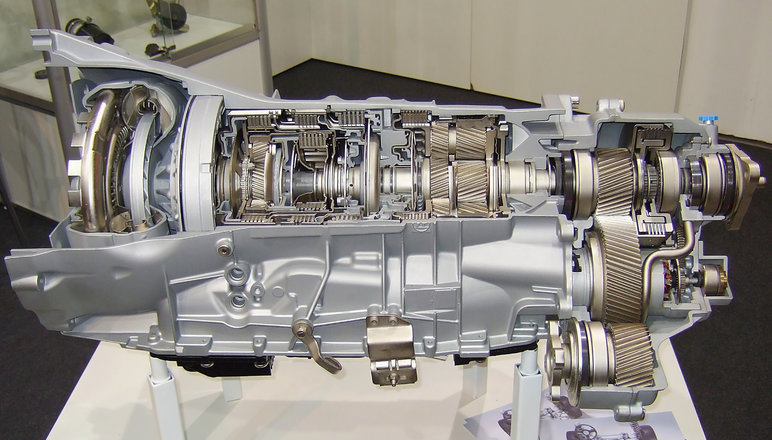
There are four basic types of automatic gearboxes. Find out how they work and how reliable they are.
The basic function of an automatic gearbox is to automatically transfer engine power to the wheels of the vehicle without the intervention of the driver. Manufacturers achieve this in different ways.
However, the gearboxes are always controlled in the same way - to drive, it is enough to select one of the modes described below on the gearbox selector.
Automatic gearbox controls
P - Park
R - Reverse
N - Neutral - putting the gearbox out of action, for example, for the needs of towing the vehicle.
D - Drive
Additional modes
M - Manual - manual selection of gears (only for gearboxes equipped with this function).
S - Sport - sports mode keeping the engine revs higher.
W - Winter - winter mode improving traction on snow and ice.
B - Brake - recuperation of electric energy in electric cars and hybrids.
⚙️ Types of automatic gearboxes
The basic types of automatic gearboxes are:
- Robotic gearbox
- Automatic gearbox with torque converter
- Dual clutch automatic gearbox
- CVT continuously variable gearbox
1. Robotic gearbox
The robotic gearbox is the simplest in terms of construction and also the cheapest way for manufacturers to offer customers automatic shifting. In essence, it is a manual gearbox supplemented by an electromechanical control that operates the clutch and gear changes. Thanks to this, the manufacturer can produce both manual and automatic cabinets on the same line and save costs.
Customers will also be pleased with the very low surcharge for an automatic compared to a manual. However, what pleases them significantly less is the behavior and driving behavior of this gearbox. Starts are often jerky, the ride is not smooth and the shifting itself takes an unreasonable amount of time. The same design as the manual gearbox simply does not allow quick gear changes or long-term clutch slippage.
Robotized gearboxes have thus taken hold mainly in cheap models. They can also be found in older sports cars, where they work more aggressively.
Maintenance and reliability of the robotic gearbox
As the robotic gearbox is very similar to the manual, it does not require particularly increased care compared to it. If the manufacturer does not specify an oil change interval in the gearbox, then change it after 200,000 km / 120,000 miles (as with manual gearboxes). The clutch then wears out, but its price is the same as for the same car with a manual gearbox.
2. Automatic gearbox with torque converter
This is the most widespread type of automatic gearbox, the roots of which go back to 1948. The principle of a classic automatic gearbox lies in the hydrodynamic converter that replaces the clutch in the gearbox. A pump is located on the engine crankshaft that drives oil to a turbine located on the gearbox input shaft. Thanks to this, the gearbox can work with almost unlimited slippage and starts and slow coasting are perfectly smooth.
The constant slippage of the gearbox resulted in increased fuel consumption in older cars, but modern gearboxes have a so-called converter lock, which firmly connects the engine to the gearbox during steady driving and thus prevents unwanted slippage and thus increased consumption.
Today, a large number of manufacturers rely on the classic automatic, because it offers the highest level of comfort for the driver, and the speed of shifting is often comparable to dual-clutch gearboxes.
Maintenance and reliability of the automatic gearbox with torque converter
Classic automatic gearbox usually has an extremely long service life, but it is necessary to change the oil in it regularly. The recommended oil change interval is usually 60,000 km / 35,000 miles or 4 years, whichever comes first. If the vehicle manufacturer indicates that the oil fill is for life, then know that the life means only a two-year warranty, and neglecting oil changes can lead to the destruction of the gearbox.
3. Dual-clutch automatic gearbox
Dual-clutch gearbox is known by most motorists as DSG, which is the trade name of the Volkswagen concern. However, you can also come across PDK from Porsche, S tronic from Audi and many other names. We have described the working principle of the dual-clutch gearbox in detail in a separate article about DSG.
In general, dual-clutch gearboxes are characterized by very fast shifting, which is why we can find them today in many super sports models from Porsche, McLaren or Ferrari. Compared to an automatic with torque converter, however, starts and gear changes are a little less smooth.
Maintenance and reliability of the dual-clutch automatic gearbox
Double-clutch gearboxes can generally be described as reliable, but the clutches in them can fail if the oil in the gearbox is not changed regularly or if the clutches are so-called dry. For transmissions with dry clutches, it is recommended to change the oil after 60,000 km / 35,000 miles, in the case of wet clutches, after 120,000 km / 75,000 miles. More information on DSG reliability can be found in the separate article on DSG.
4. CVT gearbox
CVT transmission (also known as variator) is known mainly from Japanese cars and hybrids. It is also used in most scooters and ATVs. Unlike other types of automatic gearbox, it does not have gears with predetermined gear ratios in its guts, but consists of two opposing cones connected by a drive belt. The mutual movement of the cones achieves an ideal gear ratio in every driving situation.
The absence of gears results in an extremely smooth and economical drive, as the transmission can change the wheel speed at any time independently of the engine speed. But this also results in a certain lack of character in the drivetrain, which is why the transmission never found its way to fans of sports driving. The CVT transmission is most often found in hybrids or plug-in hybrids.
Maintenance and reliability of the CVT gearbox
Today, CVT gearbox is considered almost faultless. However, it is not very suitable for traveling at a constant speed for long periods of time or pulling heavy trailers. Change the oil in the gearbox according to the intervals prescribed by the manufacturer or after driving 60,000 km / 35,000 miles.
Buying a used car? ✅ Check its history!
Choosing the right used car can be a challenge. Many of them may have minor or major damage, some have a rolled odometer, and some may even be reported stolen.
That's why it's important to always check the history of the car you're about to buy. Fortunately, this can be easily done online at Cebia.com, the largest database of used vehicle records in Europe. On Cebia.com, you can check the following information (the scope of information varies for each vehicle):
- Odometer Check (Mileage History)
- Damage Check
- Theft Check
- Taxi Check
- Advertisement Photos and Records
- Service History
- Records from State Databases
- and much more
Check vehicle history:
💰 Tip: Want to get a 10% discount on Car History Report? Simply subscribe to our newsletter and we’ll immediately send the discount to your email -> Subscribe.