

 Czech
Czech Slovak
 German
 Romanian
 Ukrainian
 Italian
 French
 Dutch
Dutch Polish
EGR valve - What is it and can you drive without it?
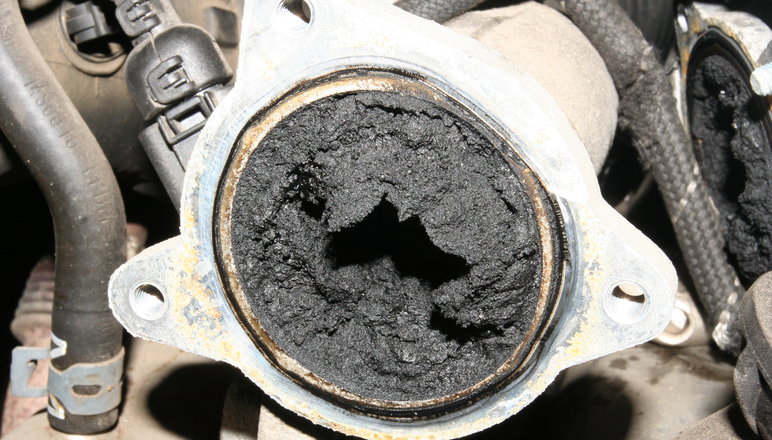
The goal of EGR is to reduce emissions, but it can really annoy the driver. Why is it the ticking bomb of diesel engines?
Purpose of EGR valve
The abbreviation EGR stands for exhaust gas recirculation. The EGR valve first appeared in diesel engines, but in recent years it has also been widely used in gasoline engines. It has only one purpose - to reduce emissions.
The EGR valve reduces the emissions of toxic nitrogen oxides, which are created during the combustion of the so-called lean mixture, when the fuel is mixed with an excess of air. This is typical for diesels, but also for some gasoline engines when driving at a constant speed with low engine load.
How the EGR valve works
The EGR valve is a component connecting the exhaust pipe and the intake of the engine. Simply put, it returns part of the exhaust fumes to the intake, where it mixes with the fuel/air mixture. The presence of exhaust gas in the cylinder results in a reduction of the maximum combustion temperature, thereby reducing the amount of nitrogen oxide.
However, the whole process is very sensitive to the precise dosing of exhaust gases - in the case of an excessive proportion of exhaust gases, there is imperfect combustion, increased hydrocarbon emissions, fuel consumption and rough engine operation.Therefore, the EGR valve is controlled by the engine electronics, which regulates the opening of the valve and thus the amount of exhaust gases.
The EGR valve opens only after the engine warms up and at low and medium loads. At full engine load, the valve remains closed.
Why is the EGR valve causing problems?
Rather than the valve itself, the problem is caused by the exhaust fumes containing the so-called carbon - soot produced during combustion. With operation, they slowly but surely settle both in the EGR valve itself, as well as in the intake and on the intake valves.
After a certain period of carbon deposits, the EGR valve becomes completely immobile. If this happens in its closed position, the engine can usually be started and you as the driver will not notice anything. The engine only has higher emissions. Many motorists blind their EGR valve on purpose - it prevents expensive repairs, but they may have problems with MOT, because in this case the car emits an excessive amount of emissions.
A bigger problem occurs when the valve gets stuck in the open position.You probably won't even start the engine, and if you do, white smoke will pour out of the exhaust and the engine will die after a while.
The only solution is to visit a service center, where they will either clean the EGR valve (if it is still possible) or replace it entirely with a new one. On that occasion, it is a good idea to check and clean the intake and intake valves, where carbon also likes to settle.
Symptoms of a faulty EGR valve
A malfunction of the EGR valve can manifest itself in several ways:
- Turning on the check engine light
- Switching the engine to emergency mode
- Difficult or completely impossible to start when cold
- Loss of power when accelerating
- Uneven engine running
Internal EGR
In some engines, exhaust gas recirculation takes place directly inside the engine (i.e. without the presence of an EGR valve). Using variable valve timing, it is possible to extend the opening of the exhaust valves and, conversely, to speed up the opening of the intake valves, thereby sucking part of the exhaust gases back into the cylinder without the need to use a direct connection of the exhaust and the intake using the EGR valve.
But this elegant solution is not efficient enough, so most modern engines rely on the EGR valve.
Modern cars are better
Car manufacturers are constantly trying to improve the life of the EGR valve. For example, by taking the exhaust fumes past the diesel particulate filter (DPF), which removes a significant percentage of the carbon-forming particles. In addition, in engines with AdBlue technology, the EGR valve is used much less, as pollutants are destroyed in the catalyst by injecting AdBlue.
A clogged EGR valve thus remains a burning problem, especially in old diesel vehicles, where you also most often encounter its blinding.
EGR valve service life
The serviceability of the EGR valve depends on the type of engine and the style of its use and cannot be easily determined. However, in general, the more kilometers a car has driven, the higher the probability of valve clogging.
Therefore, for example, when choosing a used car, it is important to check in time and thoroughly that no one has tampered with the tachometer and that the indicated mileage corresponds to reality. The most reliable way to do this is to check the vehicle's history - this can be checked online at Cebia.com.
In addition to mileage history, previous damage, service history, photos and much more can be found.
Buying a used car? ⚠️ Check its history!
Choosing the right used car can be a challenge. Many of them may have minor or major damage, some have a rolled odometer, and some may even be reported stolen.
That's why it's important to always check the history of the car you're about to buy. Fortunately, this can be easily done online at Cebia.com, the largest database of used vehicle records in Europe 🌍. On Cebia.com, you can check the following information (the scope of information varies for each vehicle):
- Odometer Check (Mileage History)
- Damage Check
- Theft Check
- Taxi Check
- Advertisement Photos and Records
- Service History
- Records from State Databases
- and much more
Check vehicle history:
💰 Tip: Want to get a 10% discount on Car History Report? Simply subscribe to our newsletter and we’ll immediately send the discount to your email -> Subscribe.
---
SK version: EGR ventil - Na čo slúži a prečo často zlyháva?
DE version: EGR-Ventil – Was ist das und warum macht es Probleme?
CZ version: EGR ventil - K čemu slouží a proč často zlobí?
RO version: Supapa EGR - Pentru ce este și de ce cauzează probleme?