

 Czech
Czech Slovak
 German
 Romanian
 Ukrainian
 Italian
 French
 Dutch
Dutch Polish
How the ESP system works in a car
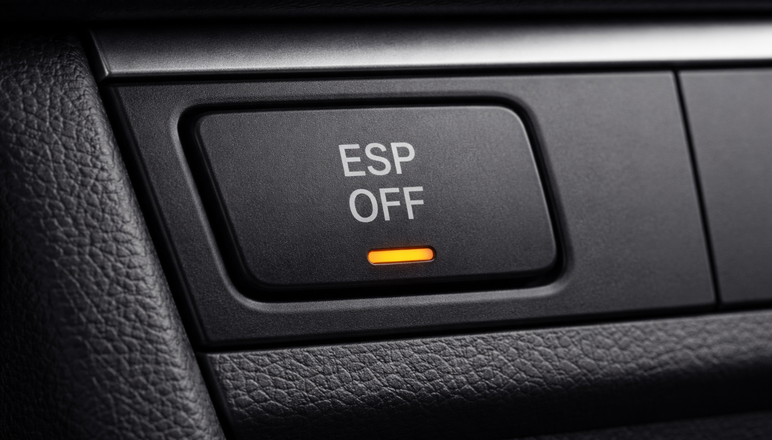
ESP is among the most important safety systems in modern automobiles. It helps manage skidding, maintain driving direction, and keep control over the vehicle even in emergency situations.
What is ESP and what is it for?
ESP (Electronic Stability Program), sometimes also referred to as ESC, is an electronic stabilization system whose task is to prevent skidding and loss of control over the vehicle. It monitors whether the driving direction corresponds to where the driver is turning the steering wheel, and intervenes immediately in case of a discrepancy.
The system activates automatically and functions at any speed. It is designed primarily for emergency situations, such as fast cornering, an evasive maneuver, or driving on a slippery surface.
Why ESP is so important
ESP is considered one of the most essential safety features of an automobile. According to available data, it can prevent up to 80% of accidents caused by skidding. For this very reason, this system has become mandatory equipment for new vehicles homologated in the EU.
Thanks to ESP, the driver has a significantly higher chance of keeping the vehicle under control even in situations where the physical limits of the tires are starting to reach their edge.
⚙️ How ESP works in practice
ESP works as an invisible safety net. Up to 25 times per second, the control unit compares data from a range of sensors, for example:
- steering wheel angle,
- speed of individual wheels,
- centripetal acceleration,
- engine speed and torque.
If the system evaluates that the car is moving in a different direction than corresponds to the steering, it intervenes. Most often:
- it reduces engine power,
- it brakes a specific individual wheel.
In an oversteer skid, the outer front wheel is typically braked, while in an understeer skid, it is the inner rear wheel. Thanks to this, the vehicle returns to a stable position very quickly, often within a fraction of a second.
What systems ESP consists of
ESP is not an independent element, but a complex system that integrates several technologies. These may include, for example:
- ABS (anti-lock braking system),
- ASR (traction control system),
- EDS (electronic differential lock),
- brake assistant,
- hill start assist.
Thanks to this cooperation, the car remains controllable even during sharp braking or acceleration on a slippery surface.
🟠 ESP warning light: what does it mean?
The ESP warning light on the dashboard can signal various states:
-
Flashing ESP light
It means that the system is currently intervening. Typically, it appears only for a moment during loss of traction or a slight skid. -
Permanently lit ESP light
Signals that the system is turned off or that a malfunction has occurred. In such a case, ESP does not perform its function.
Is ESP the same as traction control?
It is not. While traction control is usually part of ESP, it has a different task. While ESP addresses vehicle stability in corners and during skidding, traction control prevents excessive wheel spin during acceleration.
For example, when starting on a wet road, it limits engine power or brakes the spinning wheel to achieve the best possible traction.
💡 What happens when you turn ESP off
Turning off ESP does not always mean completely deactivating the system. In many cars, only the thresholds at which the system starts to intervene are shifted. If the situation worsens significantly, ESP can take control again.
👉 Turning off ESP (or its partial restriction) can be useful, for example:
- when starting in deep snow,
- when trying to free the car from a slippery surface.
On the contrary, during normal driving on the road, turned-off ESP can mean a higher risk of losing control over the vehicle, especially in emergency situations.
Buying a used car? ✅ Check its history!
Choosing the right used car can be a challenge. Many of them may have minor or major damage, some have a rolled odometer, and some may even be reported stolen.
That's why it's important to always check the history of the car you're about to buy. Fortunately, this can be easily done online at Cebia.com, the largest database of used vehicle records in Europe. On Cebia.com, you can check the following information (the scope of information varies for each vehicle):
- Odometer Check (Mileage History)
- Damage Check
- Theft Check
- Taxi Check
- Advertisement Photos and Records
- Service History
- Records from State Databases
- and much more
Check vehicle history:
🎁 Tip: Want to get a 10% discount on Car History Report? Simply subscribe to our newsletter and we’ll immediately send the discount to your email -> Subscribe.