

 Czech
Czech Slovak
 German
 Romanian
 Ukrainian
 Italian
 French
 Dutch
Dutch Polish
What is OBD? Everything about the diagnostic socket in your car
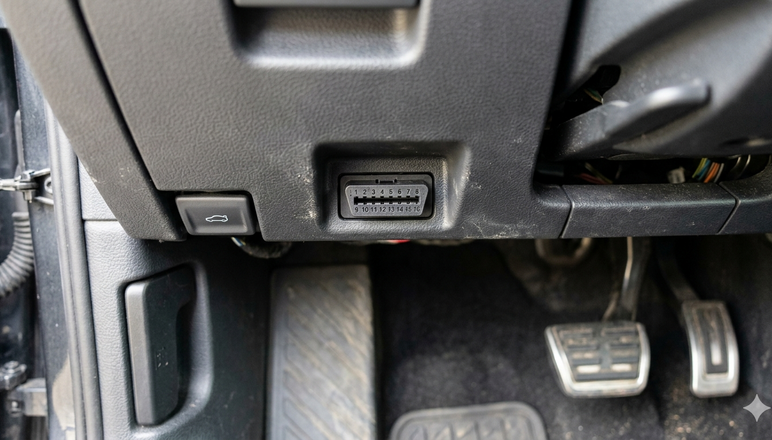
You may have noticed it while vacuuming the interior or during a service visit. A small plastic socket, usually hidden under the steering wheel, is the gateway to your car's "brain".
We are talking about OBD-II, an international standard that fundamentally changed the way we repair and inspect automobiles. 🚗
What does the acronym OBD mean?
OBD (On-Board Diagnostics) represents a set of standards for the electronic control of vehicle subsystems. While the first versions from the 1980s could only light up a malfunction indicator lamp (MIL) without further explanation, the modern OBD-II standard (also known as EOBD in Europe) is much more communicative.
This standard unified the diagnostic connector (16-pin) and introduced a universal communication language. Thanks to this, service centers and emission testing stations worldwide can verify the state of combustion and engine management in any modern vehicle.
Since when must a car have OBD-II?
This standard is mandatory for manufacturers. On the European market, the obligation applies as follows:
-
Petrol engines: mandatory since 2001.
-
Diesel engines: mandatory since 2004 (however, diesel vehicles were commonly equipped since 2003).
-
In the USA, the OBD-II standard has been common in most vehicles since 1996.
What is diagnostics used for?
Car diagnostics is not just about reading errors. It is a complex tool that can handle:
-
ECU Identification: Displays data about the control unit (manufacturer, programming date, part number).
-
Fault Memory: Lists errors and distinguishes whether it is a static or sporadic error (which disappears over time if it does not recur).
-
Real-time Data Monitoring: Display of so-called live data and readiness status (readiness of emission systems).
-
Settings and Service: Resetting service intervals, firmware updates, or restoring factory settings.
-
Testing: Verifying actuators connected to the control unit.
Interesting fact: The socket is also used for the so-called transport mode. This is activated by the manufacturer to limit electricity consumption (turns off the radio, daytime running lights, or online communication) during the transport of the car to the dealer.
🔍 Where can you find the socket in the car?
Most cars have the diagnostic port located on the left under the steering wheel. However, in some models, you can find it in the center console or other locations.
DIY Diagnostics: Mobile and Bluetooth
Today, you no longer need expensive devices. All you need is a Bluetooth adapter costing a few hundred crowns and an application on your smartphone. 📱 There are also cheap diagnostic cables, but connecting them to a computer tends to be more complicated.
⚠️ What to watch out for:
-
Cheap applications are often limited in the free version and may not display all errors.
-
Official service centers use certified devices. Unauthorized readers may not read relevant data.
Although diagnostics is a great help for orientation, the complex microprocessors in modern cars should primarily be in the hands of professionals.
Buying a used car? ✅ Check its history!
Choosing the right used car can be a challenge. Many of them may have minor or major damage, some have a rolled odometer, and some may even be reported stolen.
That's why it's important to always check the history of the car you're about to buy. Fortunately, this can be easily done online at Cebia.com, the largest database of used vehicle records in Europe. On Cebia.com, you can check the following information (the scope of information varies for each vehicle):
- Odometer Check (Mileage History)
- Damage Check
- Theft Check
- Taxi Check
- Advertisement Photos and Records
- Service History
- Records from State Databases
- and much more
Check vehicle history:
💰 Tip: Want to get a 10% discount on Car History Report? Simply subscribe to our newsletter and we’ll immediately send the discount to your email -> Subscribe.