

 Czech
Czech Slovak
 German
 Romanian
 Ukrainian
 Italian
 French
 Dutch
Dutch Polish
Engine oil change
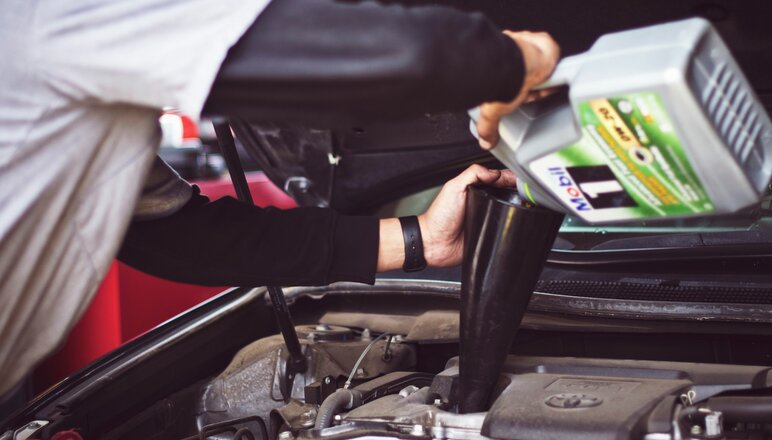
How is the oil change done and how often do you have to do it?
Changing the oil is one of the most important service operations in the maintenance of gasoline, diesel and all other four-stroke engines. Engine oil ensures the lubrication of extremely stressed engine parts and at the same time traps dirt in the engine. Without enough oil, the engine seizes and the vehicle becomes immobile.
🗓️ How often to change engine oil?
The engine oil change interval is usually set by the vehicle manufacturer and you can find it in the user manual or in the service booklet.
In general, it is recommended to change the engine oil every 15,000 km or once a year, whichever comes first. It is good to follow this rule even if the manufacturer prescribes a longer interval.
Shorter oil change interval
It is advisable to shorten the oil change interval to 7,500 km if the vehicle is used:
- only for driving short distances,
- as an emergency vehicle (fast driving with an unheated engine),
- for driving off-road using a reduction gearbox,
- for towing heavy trailers,
- for sporty driving.
💰 How much does an oil change cost?
It should be noted that together with the engine oil, the oil filter and the drain plug of the oil sump are always changed. Depending on the type of vehicle and engine, the price of a replacement at a car service ranges from approximately 50 EUR to 300 EUR.
Fortunately, changing the engine oil is not too difficult and it is possible to do it yourself (of course, only if the vehicle is no longer under warranty). This way you can easily save hundreds of euros.
⚠️ A neglected oil change can be expensive
Unfortunately, it is quite common for vehicle owners to neglect oil changes and exceed the interval. The oil in the engine gradually degrades, loses its lubricating effects and becomes dirty. Long-term operation of the engine with such oil can result in:
- Reduction of engine life due to excessive wear of its moving parts.
- Damage to the turbocharger due to impurities in the oil.
- Engine malfunctions due to clogging of oil channels with contaminated oil.
That is why it is important to strictly follow the replacement intervals and, for example, to check the service book when buying a used vehicle.
When buying a used car, check more than just oil changes
With a used car, there is much more to check than just compliance with service intervals. It is important to verify that the vehicle has not been in a serious accident, has not been stolen, or someone has deliberately rollback the odometer.
You can easily check your vehicle's history on the largest database of used vehicle records in Europe at Cebia.com. Just enter the vehicle's VIN code and you can immediately check a range of information::
- Damage check (in more than 32 countries including Germany)
- Mileage check
- Theft check
- Service and maintenance history
- Photos and advertising records
- + much more
Check vehicle history:
💰 Tip: Want to get a 10% discount on Car History Report? Simply subscribe to our newsletter and we’ll immediately send the discount to your email -> Subscribe.

What is a VIN code?
VIN (Vehicle Identification Number) is a 17-digit unique code that is the serial number of every car produced. Not only cars, but also motorcycles, commercial vehicles, trucks, trailers and motorhomes have their VINs.
You can find the VIN code in many different places on the vehicle. The exact location of the VIN is different for each vehicle, but you can always reliably find it in the vehicle's documents.
How to check the oil level?
It is a good idea to check the engine oil level regularly, as the oil can gradually decrease with operation. In some cars (e.g. BMW) the oil level is checked via an on-board computer, but a dipstick directly in the engine is more common.

To check the oil level, proceed as follows:
- Ideally, check the oil after driving so that it is warmed up to operating temperature.
- Park on level ground and turn off the engine.
- Wait 10 minutes for the oil to drain from the engine walls into the oil sump.
- Pull out the oil dipstick and wipe it with a rag.
- Insert the dipstick fully into the engine and pull it out again.
- At the end of the dipstick, you will find two lines (they are usually on theflattened part of the dipstick) - the lower line indicates the minimum amount of oil, while the upper line indicates the maximum amount.
- The oil level should always be between these lines.
- After measuring, do not forget to insert the dipstick back into the engine.
If the oil level is too low, the vehicle will warn you by the oil warning light on the dashboard.