

 Czech
Czech Slovak
 German
 Romanian
 Ukrainian
 Italian
 French
 Dutch
Dutch Polish
AWD vs 4WD: Different types of all-wheel drive
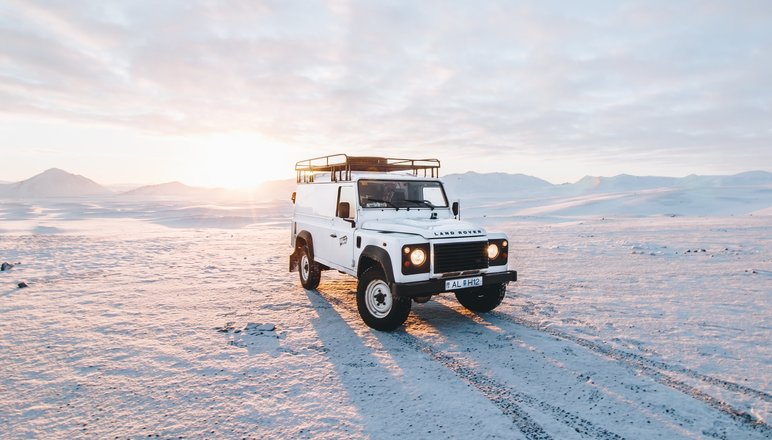
Currently, you can meet six different four-wheel drives, which differ in technology, off-road ability and intended use.
1. AWD - Full-time all-wheel drive
As the name suggests, AWD vehicles have all four wheels driven at all times while driving. The power of the engine is transmitted to the wheels through a cardan shaft and a three differentials - one between the axles and one on each of the axles.
Full-time all-wheel drive was made famous by Audi (Quattro), Subaru or the original Land Rover Defender. It is still used today by a number of large Mercedes SUVs, Range Rovers and Toyota Land Cruisers.
Three differentials ensure an even 50:50 distribution of power to both axles, but if one of the wheels slips, they result in a loss of torque on the other wheels and the car can simply get stuck with one wheel spinning.
For off-road driving, this system is equipped with an inter-axle differential lock, which eliminates the loss of torque. The lock can be controlled manually or electronically. An alternative is an inter-axle differential supplemented with a clutch (either viscous or electronically controlled).
In the latest cars, you can find a system without a lock or an inter-axle clutch. Wheel slippage is detected by an electronic system that brakes the slipping wheels and thus prevents the loss of torque of the other wheels. This system can be found, for example, in new Mercedes cars.
✔️ The most reliable all-wheel drive system
❌ Full-time all-wheel drive increases fuel consumption
2. 4WD - Part-time all-wheel drive
This type of drive completely lacks an inter-axle differential. When driving on-road, part-time AWD sends torque only to one axle, either the front or rear, depending on the make and model. When extra traction is demanded, the other axle can be engaged as well. In four-wheel drive mode the axles are firmly connected. The advantage is the elimination of the loss of torque when the wheels slip, but you cannot drive on asphalt with the four-wheel mode on - you would soon end up in a ditch.
You will find this drive in ladder frame off-roaders such as Suzuki Jimny, Toyota Hilux or other pick-ups.
✔️ Robust and simple solution - suitable for hard off-road driving
❌ You cannot drive on the road in four-wheel drive mode
3. Viscous clutch AWD
In the 1990s, four-wheel drive became popular in regular road cars, but the two systems described above turned out to be unnecessarily robust and space-consuming.
The manufacturers thus came to the market with a new solution. The differentials on the axles remained, but the central one was replaced by a viscous clutch. It has a system of slats in an oil bath. When the wheels on one of the axles slip, the difference in speed changes the viscosity of the oil and the clutch engages.
Cars with a viscous clutch thus drive only one axle for most of the time, until when it slips the clutch engages the other axle. However, the operation of the system cannot be regulated in any way due to its nature, so today it can only be found in the cheapest AWD cars - Fiat Panda, Suzuki Ignis and Suzuki Swift.
✔️ Very simple and reliable system without sofisticated electronics
❌ AWD system cannot be controlled in any way, with excessive stress there is a risk of the clutch overheating
4. Actively controlled clutch AWD
The disadvantage of the viscous clutch in the form of the impossibility of its control was solved by car manufacturers by replacing it with an actively controlled clutch. The connection of the second axle is not provided by oil, but by a hydraulic system (Haldex), or a more widespread electromagnetic system - we can find it in BMW cars with xDrive or a number of Asian SUVs - for example in the latest Suzuki Vitara.
The hydraulic and electromagnetic clutches are always actively controlled by the car's electronics. Using a series of sensors, it constantly evaluates the rotation of the wheels and in the event of a slip, it immediately connects the second axle automatically. In addition, the electronics can achieve the same effect as lockable differentials have by braking individual wheels. If the system is advanced enough, it can get the car out of situations where three out of all four wheels slip.
In many cars, this AWD system can be operated by the driver, who can choose different driving modes, or turn on the "permanent" AWD mode (it is often called Lock mode).
Even in Lock mode, however, the system does not have the same characteristics as a full-time AWD. The electronics constantly monitors the drive and disconnects the clutch at higher speeds or when the system overheats. Therefore, this system is suitable for SUVs, but not suitable for real off-road or extensive use.
✔️ Low fuel consumption, possibility to control AWD activation, no risk of clutch overheating
❌ Not suitable for long-term use or hard off-road driving
5. Twinster AWD system
Twinster is not very common AWD system. It uses three electronically controlled clutches replacing the inter-axle and rear differential. The system can not only firmly connect both axles, but also the rear wheels together (thanks to this, the popular Drift mode of the Ford Focus RS 2015 was created).
Twister allows you to drive with one axle driven and, if necessary, engage AWD and distribute the power between the rear wheels. The electronics do not have to solve wheel slippage by applying the brakes, but only by engaging the clutches.
You can find it in the Ford Focus RS, Range Rover Evoque or 2. gen Opel Insignia.
✔️ Can distribute torque between the rear wheels
❌ High demands on electronics, delay when engaging AWD
6. eAWD - Electric all-wheel drive
Electric all-wheel drive can be found not only in electric cars, but also in hybrids, where the system is designed to save weight and space. The principle is simple: the axles are not mechanically connected by shaft, but each of them has its own drive. In hybrids, the front axle is usually driven by an internal combustion engine and the rear one by an electric motor.
The electronics then automatically engages the electric motor whenever needed. You can find this solution in Lexus, Toyota and other hybrid vehicles.
The performance of the electric motor is very important - if it is not strong enough, the drive cannot cope with more demanding situations and is completely unsuitable for off-road driving. Battery capacity also plays an important role. If you run out of juice, your off-road capabilities can become very limited.
However, for pure electric cars with a large battery capacity, eAWD can surpass all other AWD systems. The electronics can distribute energy to the individual wheels completely arbitrarily, and the maximum torque is available from zero engine revolutions.
✔️ Can outperform all other AWD systems
❌ Requires sufficient electric motor power and battery capacity
Buying a used car? ✅ Check its history!
Choosing the right used car can be a challenge. Many of them may have minor or major damage, some have a rolled odometer, and some may even be reported stolen.
That's why it's important to always check the history of the car you're about to buy. Fortunately, this can be easily done online at Cebia.com, the largest database of used vehicle records in Europe. On Cebia.com, you can check the following information (the scope of information varies for each vehicle):
- Odometer Check (Mileage History)
- Damage Check
- Theft Check
- Taxi Check
- Advertisement Photos and Records
- Service History
- Records from State Databases
- and much more
Check vehicle history:
💰 Tip: Want to get a 10% discount on Car History Report? Simply subscribe to our newsletter and we’ll immediately send the discount to your email -> Subscribe.